INTRODUCTION
In the medical laboratory, we have spent decades perfecting the “What”, what is the patients hemoglobin? What is the glucose level? What bacteria is growing in their culture?
We have become exceptionally fast, accurate and precise at generating these numbers. But as we move deeper into 2026, the healthcare landscape is shifting.
The “Industrial Revolution” of the labs defined by high throughput labs/ analysers and speed is hitting the ceiling. To break through we must embrace the “so what”: So what does the specific results mean for this specific patient, in their specific clinical context?
THE CEILING OF RULE BASED MEDICINE:
For years, haematology and chemistry labs have relied on middleware rules. These are simple ‘if- then’ logic gates (if potassium > 6.0, trigger a critical alerts). While effective for safety these rules are linear and isolated. They treat the patient as a single data points rather than a complex biological system.
In our current Information Age, the variables are increasing in complexity from genomics to multi-omits. Humans simply cannot calculate the correlation between 50 different lab parameters, medication, history and age related trends in real time.
THE SHIFT:
Data Science allows us to move from linear rules to multi dimensional patterns. Artificial intelligence (AI) doesn’t just look at ‘high glucose’ it looks at the rate of change (delta checks) across five previous visits, cross references it with the patients BMI and HbA1c and calculates the probability score for diabetic ketoacidosis before it becomes a clinical emergency.
THE DILEMMA:
One of the biggest hurdles I have researched is the consequence gap in high stake environments like flow cytometery or bone marrow morphology etc. In these sub specialities an error isn’t just a wrong number, it’s an incorrect leukaemia diagnosis.
Currently AI, is mostly used for cell pre classification, but many may fear the “Black Box” problem.
If AI is wrong, who is responsible?
This is where Cybersecurity and Explainable AI (XAI) becomes essential.
By integrating cybersecurity frameworks we ensure that:
- Data integrity: The images used to train the AI haven’t been tampered with.
- Audit trails: Every suggestion made by AI is logged, allowing the scientist to verify and sign off with complete transparency.
- Adversarial defense: We protect diagnostic systems from ‘data poisoning’ that could lead to systematic misdiagnosis.
SAVING HEALTHCARE COSTS FROM SKY ROCKETING:
Post COVID, healthcare systems are struggling with massive debt and staffing shortages. The labs are often seen as a cost centre, but it holds the ket to the solution.
70% of medical diagnostic decisions are based on lab data. By using data science to implement clinical decision support system (CDSS) the lab can lead the charge in:
- Predictive stock management: using AI to forecast reagent usage, preventing expensive waste or critical stockout.
- Preventative over testing: AI can flag ‘redundant’ test orders. Ex: LDH test ordered twice in 4hrs, based on biological 1/2 life, saving millions in unnecessary costs.
- Population health: Identifying early stage chronic kidney by scanning thousands of routine creatinine results, allowing for intervention before expensive dialysis is needed.
MOVING FROM TECHNICAL TO DIAGNOSTIC CONSULTANT:
The most exciting part about this journey is how AI helps MLS become more medical.
By using AI driven interpretation we stop reporting numbers and start answering clinical questions. Along with the previous results, we provide a virtual diagnostic map.
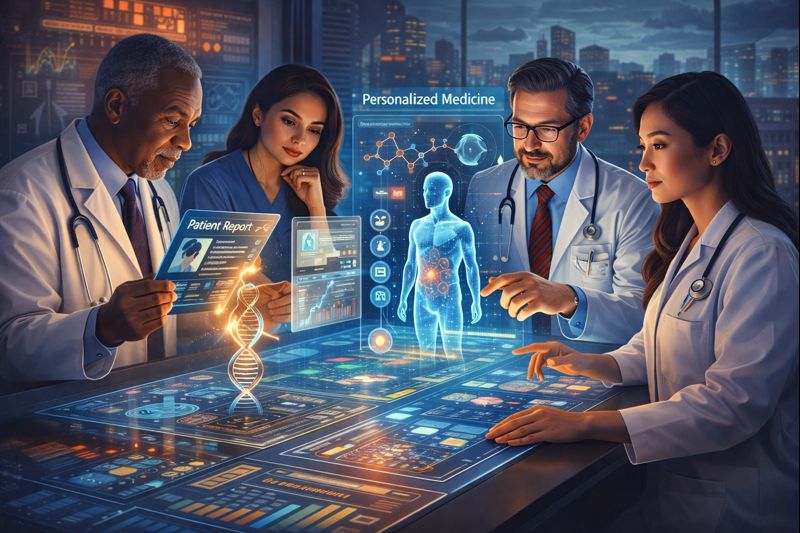
Imagine a multi-speciality care team meeting where the MLS doesn’t just read a result, but presents a dashboard pulling from the EHR, imaging and lab results to show a patient’s response to chemotherapy. This is the future of our profession.
“The lab specialists should be open for new technology rather than fearing the unknown. AI won’t replace the scientist, it will replace them who refuse to use it”
THE MISSION:
As a medical laboratory scientist (MLS) certified in Artificial Intelligence (AI), data science and cybersecurity, I have spent the last few years exploring this exact frontier. Here is why the integration of these fields is no longer optional, it is the next phase of our professional evolution.
I am starting a 12 month sprint to build 100 projects that prove this concept. My first month is dedicated to Exploratory Data Analysis (EDA) on 10 authentic healthcare datasets.
I will be looking at everything related to healthcare from predictive analytics in clinical chemistry to haematology delta checks and microbiology antibiograms, explaining every step of the python code and every clinical insights along the way.
“The future of the lab is Bio-Digital. It is smarter, faster and secure.”