
A delayed diagnosis is rarely just a clinical problem anymore. When a critical chemistry run is halted, or stat result fails to cross from analyser to the middleware or electronic health record (EHR), the root cause might not be a mechanical failure or connectivity problem. In today’s highly connected digital healthcare systems, it could be a “cyberattack“.
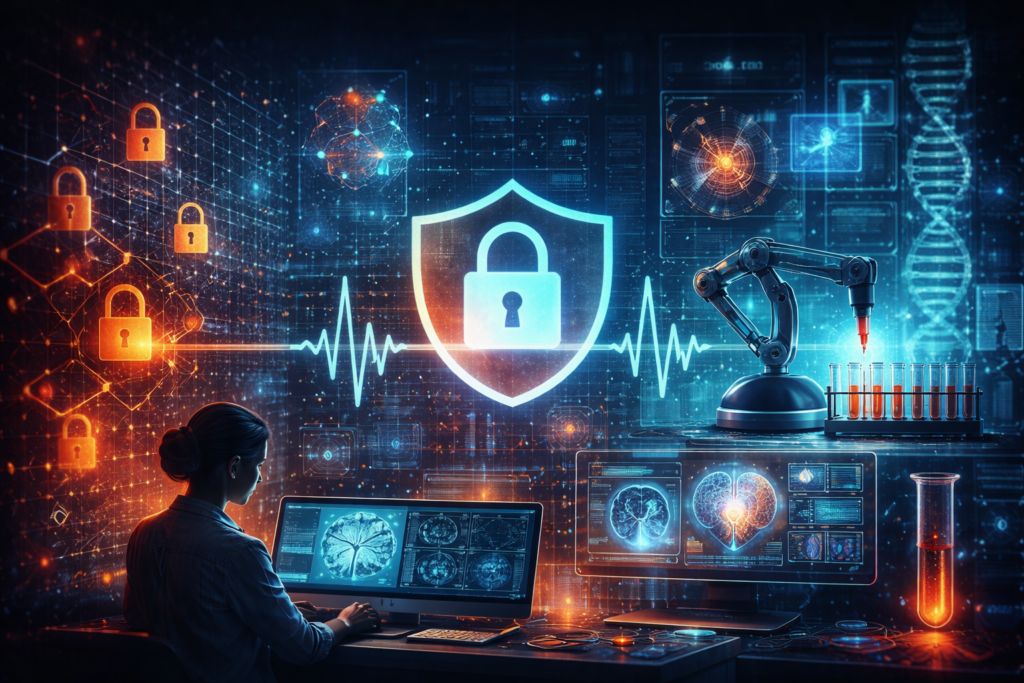
The Silent Threat in Modern Diagnostics
The modern diagnostic ecosystem is no longer confined to a single laboratory. It is a highly interconnected digital network.
As medical diagnostics and healthcare rapidly adopts electronic health records, cloud platforms, connected medical devices and AI driven diagnostics, it is becoming one of the most digitally advanced and most vulnerable industries in the world. The same interconnected systems that enable faster, more accurate patient care are also expanding the attack surface for cyber threats.
This increasing digitalisation and automation has significantly improved efficiency, scalability, and clinical accuracy. However, it has also introduced a critical challenge:
An exponentially expanding attack surface
Each connection point whether it is a middleware system, analyser interface, remote access portal, or cloud integration represents a potential entry point for attackers.
Medical diagnostics and healthcare organisations are now prime targets for cybercriminals not only because of the high value of sensitive patient data but also due to the critical need for uninterrupted operations. A single ransomeware attack or system breach can disrupt laboratory workflows, delay diagnostic results and compromise clinical decision making, ultimately impacting patient safety and trust.
Traditional cybersecurity approaches, which rely heavily on manual intervention and reactive response, are no longer sufficient to protect modern healthcare infrastructures. As cyber threats become more complex, dynamic and difficult to detect, there is an urgent need for systems that can identify risks earlier, respond faster and operate intelligently in real time.
Modern attackers are no longer relying solely on known vulnerabilities. Instead, they are exploiting zero-day vulnerabilities previously unknown weaknesses that bypass traditional signature-based detection systems.
These attacks are harder to detect, faster to execute and significantly more damaging.
As healthcare systems become more complex, the challenge is no longer just securing individual systems, it is securing an entire digital ecosystem in real time.
The Risk Landscape: Why Healthcare Diagnostics is Highly Vulnerable
Medical diagnostics sits at a unique intersection of high value data, critical operations and continuous demand making it an especially attractive target for cyberattacks.
Unlike many other industries, healthcare cannot afford downtime.
A single disruption can delay test results, interrupt workflows and impact clinical decision making. This urgency creates pressure points that attackers actively exploit.
The most common and impactful cyberthreats in healthcare include:
- Ransomeware Attacks: Attackers encrypt systems and demand payment to restore access. In diagnostic environments, this can halt laboratory operations, delay urgent testing and disrupt patient care.
- Data Breaches: Healthcare systems store highly sensitive patient data, including medical histories, diagnostic results and personal identifiers. This data is extremely valuable and difficult to replace making healthcare a prime target.
- Insider Threat: Whether intentional or accidental, internal access to systems increases the risk of data exposure and system compromise.
- Network level Vulnerabilities: Unsecured communication channels, weak authentication systems and outdates infrastructure can expose entire networks to attack.
- Medical device and system vulnerabilities: Diagnostic analysers, IoT based monitoring systems and connected devices often operate on legacy or poorly secured software, creating additional risk.
Common vulnerabilities includes weak passwords, insecure web interfaces, SQL injection and command injection flaws and unencrypted data transmission.
The impact of these attacks goes beyond financial or operational damage. They can disrupt diagnostic services, compromise patient privacy and undermine trust in healthcare systems.
The Gap: Where Technology is Advancing than Cybersecurity
While diagnostic technology is advancing rapidly, cybersecurity integration has not kept pace. We are building state of the art predictive analytics and automated workflows on top of fragile digital foundations.
Many diagnostic systems, from advanced imagining modalities to high throughput biochemistry analysers, run on legacy software or outdated operating systems that cannot be easily patched without voiding vendor warranties or disrupting accredited quality assurance processes.
Yet many cybersecurity frameworks still rely on:
- Rule based detection systems
- Manual interventions
- Fragmented security layers
- Reactive incident response
This creates a critical gap.
Key limitations of current approaches:
- Reactive security models: Most systems detect threats after they occur rather than preventing them.
- Alert fatigue in security teams: High volumes of alerts make it difficult to identify real threats quickly.
- Lack of predictive intelligence: traditional systems struggle to detect unknown or evolving threats.
- Poor integration with clinical workflows: Security systems often operate separately from healthcare operation, reducing efficiency.
- Scalability challenges: As systems grow, maintaining consistent security across all layers becomes increasingly difficult.
Even advanced solutions such as encryption and blockchains introduce tradeoffs such as increasingly system latency or reducing usability if not carefully implemented.
The Future: Cyber Resilient Medical Diagnostic Systems
The future of diagnostics is not just digital, it must be cyber-resilient by design.
Security can no longer be an after thought boulted into the LIS, it must be an intelligent, autonomous layer embedded directly within the diagnostic workflow.
To protect the integrity of patient care, the next generation of diagnostic infrastructure needs:
- AI driven anomaly detection to monitor network traffic, user behaviour and clinical data streams in real time.
- Predictive and adaptive security models capable of identifying evolving and previously unseen threats.
- Automated response mechanisms that minimise downtime and ensure continuous system availability.
- Lightweight and scalable cryptographic protocols that secure data without compromising system efficiency.
- Blockchain based audit trails to ensure tamper resistant and transparent record keeping.
- Privacy preserving approaches such as federated learning, nibbling collaborative analytics without exposing raw patient data.
In such models, cybersecurity is no longer reactive it becomes intelligent, autonomous and embedded within the healthcare diagnostic workflow itself.
Importantly, cyber resilience is not just about preventing attacks, it is about ensuring that healthcare systems can continue to operate, adapt and recover in real time, even under active threat conditions.
From laboratory information systems and diagnostic platforms to IOT based patient monitoring and cloud based clinical analytics, every layer of the healthcare diagnostic ecosystem must be designed with resilience in mind.
The ultimate goal is clear:
“To build healthcare diagnostic systems that seamlessly balance security, efficiency and usability while ensuring uninterrupted patient care.”
Building this future together
To explore this challenge, I developed an AI powered threat hunting prototype focused on machine leaning based anomaly detection in network logs. This approach integrates supervised and unsupervised learning techniques with real time monitoring to identify both known threats and previously unseen patterns for suspicious behaviour.
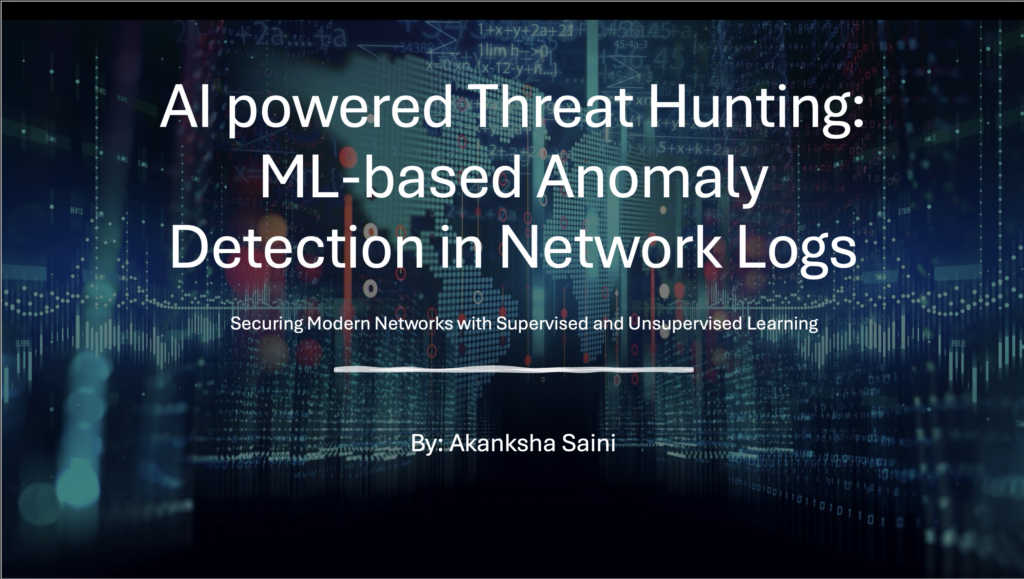
By combining machine learning, anomaly detection and automated response principles, this solutions aims to support a shift from reactive cybersecurity models towards more proactive, intelligence driven defence mechanisms. In the context of healthcare and diagnostics, this has the potential to reduce system downtime, mitigate data breaches and ultimately protect the continuity of patient care.
However, this project is not an endpoint, it is a starting point.
As healthcare and diagnostic systems continue to evolve, meaningful process in cybersecurity will depend on collaboration across disciplines. Clinicians, laboratory professionals, data scientists, cybersecurity experts and digital health leaders all have a role to play in building resilient and future ready healthcare infrastructure.
I am actively looking to connect with organisations, research groups and innovation teams working at the intersection of healthcare, AI and cybersecurity to further develop and translate this concept into real world applications.
Watch the full project walkthrough: Transforming healthcare cybersecurity with AI
Read the detailed project breakdown: [Blog Link coming soon]
If this work resonates with your interests or align with your organisation’s vision, I would welcome the opportunity to collaborate, learn and contribute to building secure, intelligent and resilient diagnostic systems for the future.
Connect with me here: Akanksha Saini